

Sheet metal tools for edge and surface processing
Sheet metal tools are used to prepare components for subsequent manufacturing steps after cutting. Depending on the initial condition and requirements, different tooling solutions are employed to remove slag, eliminate primary and secondary burrs, round edges, remove oxide layers, or create defined surface finishes.
Edge and surface finishing follows a clear process chain. After laser, plasma, oxyfuel, or punching processes, slag deposits, burrs, oxide layers, or surface irregularities can occur. These affect the coating suitability, further processing, and the quality of the finished component. The goal of the finishing process is therefore to produce a defined component condition with reproducible edge and surface properties.
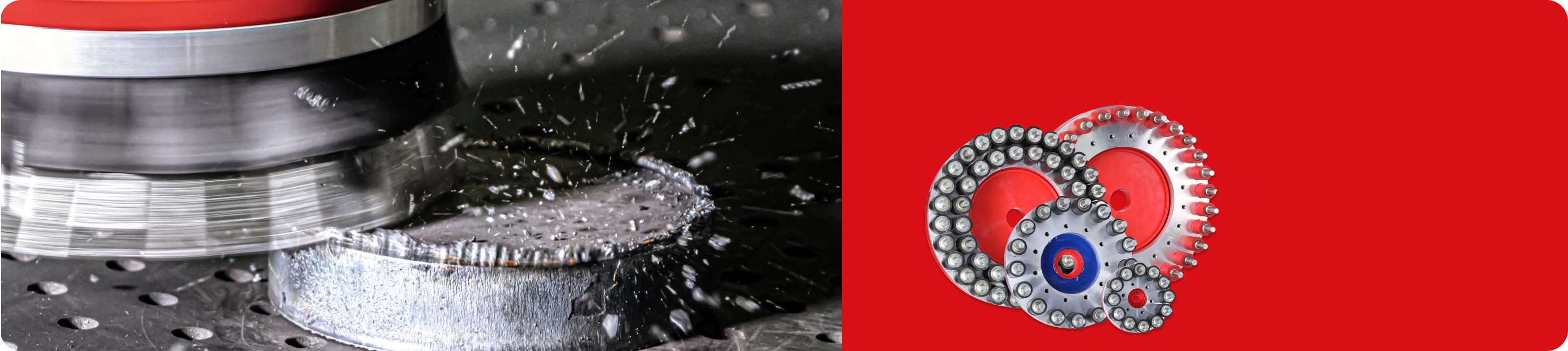
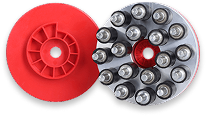
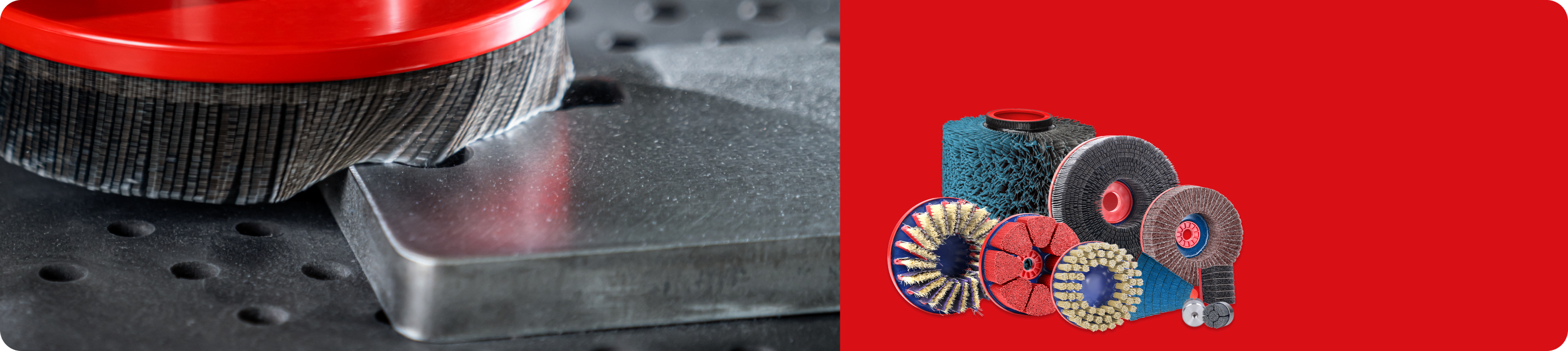
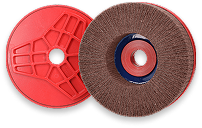
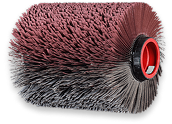
Specialized sheet metal tools are available for the various process steps. Slag hammer brushes are used for slag removal. Abrasive belts, hook and loop discs, and other grinding tools are used for pre-grinding and primary burr removal. Deburring discs, deburring rollers, deburring blocks, and brush tools are used for deburring and edge rounding. Oxide brushes and oxide rollers remove oxide layers from thermally cut components, while abrasive fleece, abrasive cloth, and polishing tools create defined surface finishes.
The selection of the appropriate tool depends on various factors. Material, sheet thickness, component geometry, initial condition, and the requirements for the edge and surface determine which tool solution enables suitable processing within the respective process step.
The coordinated use of sheet metal tools enables stable machining processes, reproducible results, and economical manufacturing workflows. At the same time, it creates the conditions for downstream processes such as powder coating, wet painting, electroplating, welding, or assembly, and sustainably improves the quality of the manufactured components.