
Sheet Metal Edge and Surface Finishing
From Slag Removal to Surface Finishing – For Defined Edge Conditions, Clean Surfaces and Reliable Downstream Processes
The Sheet Metal Edge and Surface Finishing Process
Sheet metal edge and surface finishing is a structured process chain performed after laser cutting, plasma cutting, oxy-fuel cutting and other thermal or mechanical cutting operations. The objective is to create defined component conditions with reproducible edge quality and surface characteristics for coating, welding, assembly and downstream manufacturing processes.
The process chain includes slag removal, pre-grinding, deburring, edge rounding, oxide removal and surface finishing. Each process step fulfills a specific function and contributes to a defined edge and surface condition. The quality of every subsequent operation depends on the results achieved in the previous process step.
The result is a reproducible component condition with reliable coating performance, consistent coating adhesion, reduced rework and stable downstream manufacturing processes.


Slag removal is the first process step in sheet metal edge and surface finishing after thermal cutting. Slag deposits on cut edges can interfere with downstream manufacturing operations, reduce process stability and negatively affect component quality.
During the deslagging process, slag deposits are mechanically removed to create a uniform and process-ready starting condition. Deslagging brushes are used to remove adherent slag and prepare components for subsequent processing steps.
The result is a defined component condition with clean cut edges, improved edge quality and stable downstream manufacturing processes.
Slag removal creates the foundation for pre-grinding and deburring. During these subsequent process steps, surface irregularities are reduced and primary burrs are prepared for controlled material removal.


Pre-grinding and deburring form the central preparation stage within the sheet metal edge and surface finishing process. During this step, surface irregularities are reduced and primary burrs created during laser cutting, plasma cutting and mechanical cutting are processed through controlled material removal. Without proper pre-grinding and deburring, unstable machining conditions can lead to inconsistent edge quality, increased tool wear and reduced process reliability.
During pre-grinding and deburring, abrasive coth belts, surface conditioning discs and abrasive discs are used to level the component surface, remove primary burrs and create a uniform starting condition for subsequent processing steps. These operations improve surface preparation and establish consistent conditions for further edge processing.
The result is a defined component condition with uniform surface quality, controlled edge preparation and reproducible processing outcomes.
Pre-grinding and deburring create the foundation for subsequent deburring and edge rounding operations. This enables the controlled removal of secondary burrs and the creation of a reproducible, radius-like transition between the surface and the edge.


Deburring and edge rounding focus on the controlled finishing of sheet metal edges after pre-grinding and primary burr removal. During this process step, remaining secondary burrs are removed and a reproducible, radius-like transition between the surface and the edge is created. The objective is to establish defined edge conditions that support coating performance, component safety and downstream manufacturing processes.
During deburring and edge rounding, deburring blocks, deburring discs and deburring wheels are used to remove secondary burrs and improve edge quality. Controlled material removal creates a consistent edge condition across sheet metal components while preparing the edges for subsequent processing steps.
The result is a defined component condition with reproducible edge quality, uniform coating absorption and reliable coating adhesion. Consistent edge preparation also helps reduce rework and supports stable downstream manufacturing processes.
Deburring and edge rounding create the foundation for the subsequent oxide removal process. Any remaining oxide layers generated during plasma cutting or oxy-fuel cutting must be removed to create clean metallic cut edges for coating, welding and other downstream operations.


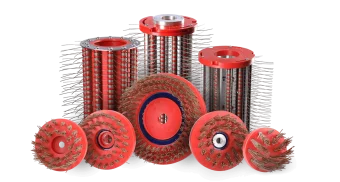
Oxide removal is the process step used to remove oxide layers that form on cut edges and component surfaces during plasma cutting, oxy-fuel cutting and other thermal cutting processes. These oxide layers can reduce coating adhesion, affect weld quality and interfere with downstream manufacturing operations.
During oxide removal, oxide brushes and oxide wheels are used to selectively remove oxide layers and create clean metallic cut edges. This process prepares sheet metal components for coating, welding and other applications that require a defined metallic surface condition.
The result is a defined component condition with clean metallic edges, improved coating adhesion and reliable downstream processing. Effective oxide removal also helps improve process stability and reduce quality issues in subsequent manufacturing steps.
Without oxide removal, residual oxide layers may remain on the component surface and negatively affect coating performance, weld quality and long-term product durability.
Oxide removal creates the foundation for subsequent surface finishing. During the final finishing process, defined surface characteristics and reproducible surface quality are established.


Surface finishing is the final step in the sheet metal edge and surface finishing process. During this stage, controlled material removal is used to create defined and reproducible surface characteristics. The objective is to establish a final surface condition that supports coating performance, component functionality and stable downstream manufacturing processes.
During surface finishing, abrasive belts, non-woven abrasive belts and polishing plate are used to level surface structures, reduce surface irregularities and create consistent surface quality. These tools enable precise control of surface characteristics and reproducible processing results across sheet metal components.
The result is a defined component condition with uniform surface quality, controlled surface roughness and reliable coating adhesion. Consistent surface finishing also improves appearance, supports coating absorption and helps reduce rework.
Without surface finishing, surface irregularities may remain and negatively affect coating quality, appearance and the reproducibility of downstream manufacturing operations.
Together, the individual process steps of sheet metal edge and surface finishing create a defined component condition with reproducible edge quality, controlled surface characteristics and stable manufacturing processes.


FAQ: Sheet Metal Deburring, Edge Rounding and Surface Finishing
Find answers to common questions about sheet metal deburring, edge rounding, slag removal, oxide removal, pre-grinding and surface finishing. Learn how each process step contributes to defined edge conditions, consistent surface quality and reliable downstream manufacturing processes.
After laser cutting, plasma cutting, oxy-fuel cutting and mechanical cutting operations, sheet metal components often contain slag, primary burrs, secondary burrs, sharp edges, oxide layers and surface irregularities.
Sheet metal edge and surface finishing creates a defined component condition with reproducible edge and surface characteristics. This improves coating performance, supports reliable coating adhesion and creates stable conditions for welding, assembly and other downstream manufacturing processes.
The complete process chain includes slag removal, pre-grinding, deburring, edge rounding, oxide removal and surface finishing.
Each process step fulfills a specific function: removing slag deposits, reducing primary burrs, eliminating secondary burrs, creating a reproducible radius-like transition between the surface and the edge, removing oxide layers and producing defined surface characteristics.
Deburring removes primary and secondary burrs created during cutting or machining operations. The objective is to create a burr-free edge without unwanted material projections.
Edge rounding creates a reproducible, radius-like transition between the surface and the edge. This improves handling safety, coating performance and the stability of downstream manufacturing processes.
A primary burr is created directly during cutting, punching or shearing operations. It appears as excess material along the cut edge as a result of the separation process.
A secondary burr can develop during subsequent processing steps when residual material is not completely removed but is plastically displaced toward the surface. Controlled material removal is therefore essential for achieving consistent edge quality.
During pre-grinding, abrasive cloth belts, hook-and-loop abrasive discs and surface conditioning discs are used to reduce primary burrs, spatter, scale and surface irregularities.
The objective is to create a uniform starting condition that allows subsequent deburring and edge rounding tools to operate consistently and produce reproducible results.
During deburring and edge rounding, deburring discs, deburring wheels and deburring blocks are used to remove secondary burrs and create a reproducible, radius-like transition between the surface and the edge.
The choice of tool depends on component geometry, machine type, material, burr formation and the required finishing result.
Sharp sheet metal edges can lead to uneven coating thickness and coating defects. As a result, coating performance and long-term corrosion protection may be compromised.
Edge rounding creates a reproducible, radius-like transition between the surface and the edge. This supports uniform coating absorption, reliable coating adhesion and improved long-term corrosion resistance.
Oxide layers are primarily formed during plasma cutting and oxy-fuel cutting operations. These layers can negatively affect coating adhesion, weld quality and further processing.
During oxide removal, oxide brushes and oxide wheels are used to remove oxide layers from cut edges and create clean metallic surfaces for reliable downstream manufacturing processes.
Surface finishing creates a defined and reproducible surface condition on sheet metal components.
During surface finishing, non-woven abrasive belts, finishing abrasive cloth belts and polishing discs are used to achieve specific surface characteristics, including linear finishes, non-directional finishes and polished surfaces.
Insufficiently finished sheet metal edges can lead to coating defects, secondary burrs, assembly issues, increased risk of injury and unstable manufacturing processes.
A coordinated process chain consisting of slag removal, pre-grinding, deburring, edge rounding, oxide removal and surface finishing helps reduce rework and supports reproducible component characteristics.
Your Contacts

Marc Böck


Anja Berscheit