
The Edge Rounding Process
Sheet Metal Edge Rounding in Industrial Manufacturing
Sheet metal edge rounding is the process of refining component edges to create reproducible, radius-like transitions between the surface and the edge. The condition of this transition zone directly influences the stability of downstream operations such as coating, welding, assembly and handling.
After thermal or mechanical cutting, as well as pre-grinding and deburring operations, sharp edges, secondary burrs and inconsistent edge transitions may remain. These conditions can affect coating performance, create uneven coating distribution and increase handling risks.
During the edge rounding process, the workpiece edge is processed in a controlled manner to create consistent transitions along the entire component geometry. The objective is not to change the geometry of the component, but to establish reproducible edge conditions that support stable downstream manufacturing processes.
A reproducible radius-like transition improves coating performance, reduces localized stress concentrations at the edge and supports consistent conditions in automated production environments.


How Do Sharp Edges and Secondary Burrs Develop?
Thermal and mechanical cutting processes can create material protrusions, sharp edge conditions and plastically deformed edge zones. These conditions result from thermal influence, material displacement and non-uniform material separation along the cut edge.
Even after pre-grinding and deburring, secondary burrs and inconsistent transitions between the surface and the edge may remain. These irregularities can affect process stability and create inconsistent edge conditions across the component.
Sharp edges generate localized stress concentrations and can negatively influence coating distribution along the edge. They also increase handling risks and may reduce process stability in automated manufacturing systems.
Particularly on coated components, sharp edge transitions often contribute to uneven coating thickness and localized coating defects. This can increase rework, scrap rates and process variation.
Edge rounding reduces these unstable transition zones and creates reproducible conditions for downstream manufacturing processes.
Deburring as the Foundation for Reproducible Edge Rounding
Deburring is a critical prerequisite for consistent edge rounding. Before the edge rounding process begins, remaining material protrusions, primary burrs and unstable edge conditions must be processed in a controlled manner.
During pre-grinding, primary burrs are reduced and surface conditions are equalized to support consistent tool engagement along the component edge. Material removal can also create localized material displacement within the surface plane.
These surface-related material displacements are referred to as secondary burrs. Controlled processing of secondary burrs takes place during the deburring and edge rounding stages.
Without a consistent starting condition, edge rounding intensity can vary along the component edge. This may result in inconsistent transitions between the surface and the edge and unstable coating conditions.
A reproducible deburring process establishes the foundation for controlled edge rounding and uniform edge geometry.
The Edge Rounding Process
During edge rounding, material is removed from the component edge in a controlled manner to create reproducible, radius-like transitions between the surface and the edge. The objective is a consistent transition zone across the entire component geometry.
The intensity of edge rounding depends on factors such as material type, sheet thickness, initial edge condition, tool geometry and selected process parameters. Feed rate, rotational speed and contact pressure all influence material removal and the resulting edge condition.
During processing, remaining secondary burrs are refined and sharp edge transitions are reduced. This creates a more uniform transition between the surface and the edge.
Edge rounding improves coating consistency, reduces localized stress concentrations and increases process reliability during manual and automated handling.
A reproducible edge rounding process creates stable conditions for coating, reduces rework requirements and supports consistent component quality.
Tools for Deburring and Edge Rounding
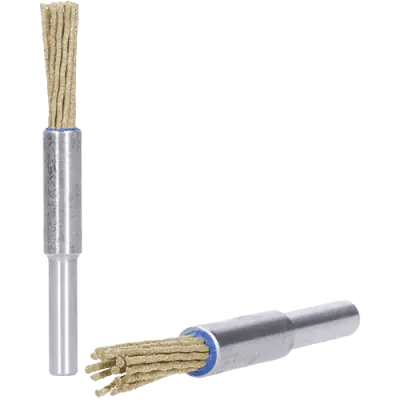
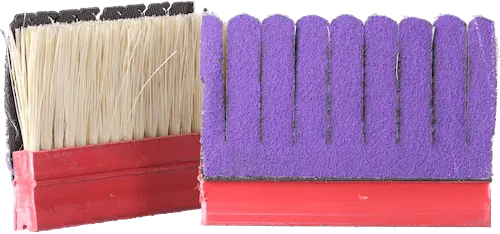
Tool selection for deburring and edge rounding depends on material type, component geometry and the required edge condition. The objective is controlled material removal that reliably processes secondary burrs and creates reproducible transitions between the surface and the edge.
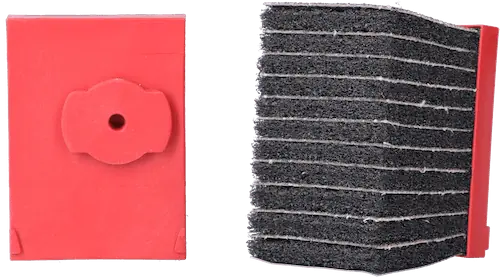
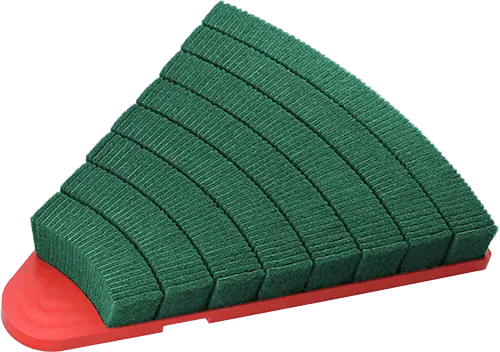
During the deburring stage, deburring blocks are used to process secondary burrs and reduce sharp edge transitions. Controlled tool engagement creates more consistent conditions for subsequent edge rounding operations.
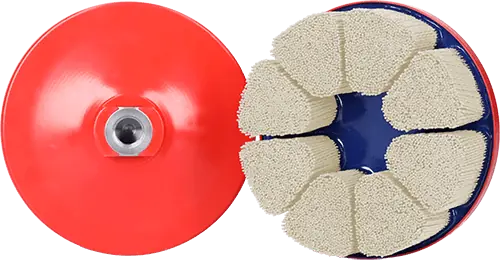
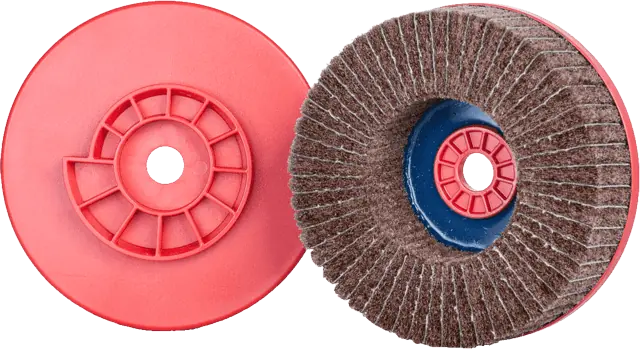
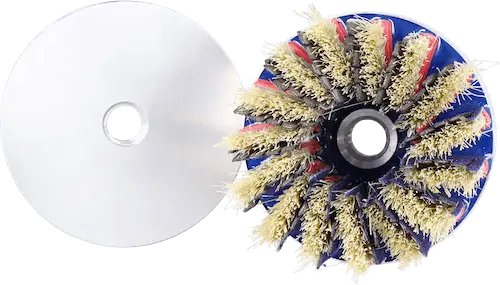
Deburring discs are used to process edge areas evenly and remove remaining burr structures in a controlled manner. This creates stable conditions for reproducible transitions between the surface and the edge.
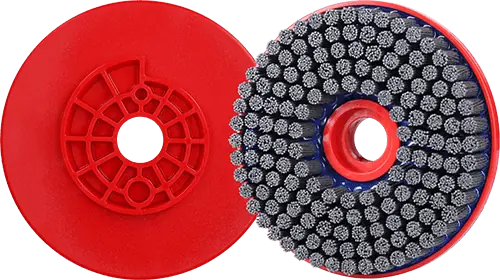
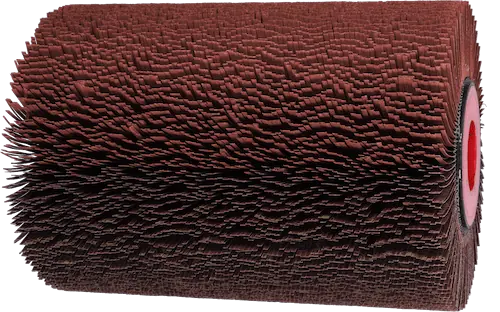
During the edge rounding process, deburring wheels are used to create uniform, radius-like transitions between the surface and the edge. Continuous tool engagement along the edge supports reproducible edge rounding results.
Tool geometry, abrasive selection and process parameters influence both the intensity of edge rounding and the consistency of the transition zone.
The result is a defined component condition with uniformly processed edges, reduced burr structures and stable conditions for downstream processes such as coating, assembly and handling.

Why are reproducible Transitions between Surface and Edge important?
The transition between the surface and the workpiece edge directly affects the stability of downstream manufacturing and coating operations. Sharp or inconsistently processed transitions create localized stress concentrations, uneven coating performance and unstable processing conditions.
Controlled deburring and edge rounding create consistent, reproducible transition zones along the entire workpiece edge. This reduces process variation and creates stable conditions for subsequent manufacturing operations.
In coating applications, a consistent transition between the surface and the edge improves coating thickness distribution. At the same time, the risk of localized coating defects and premature material stress at sharp edge zones is reduced.
In automated manufacturing environments, the consistency of the workpiece edge also affects tool engagement, process stability and the reproducibility of manufacturing results.
A reproducible radius-like transition reduces rework, improves handling safety and supports stable downstream manufacturing processes in industrial sheet metal fabrication.
Success Stories from our Customers
Through customer-specific tool adaptations, process times can be significantly reduced. One customer application demonstrated that processing time during deburring was reduced by up to 80%.
The latest generation of deburring discs maximizes abrasive contact through an optimized flap arrangement and slot structure. This increases material removal at the sheet metal edge and significantly improves machine performance.
Customers benefit from our extensive application knowledge and process experience. This expertise helps create efficient manufacturing processes and supports reliable production performance.
Deburring & rounding with tools from boeck
You are currently viewing a placeholder content from YouTube. To access the actual content, click the button below. Please note that doing so will share data with third-party providers.
More informationCompatible with Leading Machine Manufacturers
FAQ: Sheet Metal Edge Rounding
Find answers to common questions about secondary burrs, edge rounding processes, tool selection and the creation of reproducible transitions between the surface and the workpiece edge. Learn how controlled edge rounding improves coating performance, handling safety and process stability in industrial sheet metal fabrication.
Sheet metal edge rounding is the controlled processing of workpiece edges to create reproducible, radius-like transitions between the surface and the edge.The objective is to establish consistent edge conditions that improve coating performance, handling safety and the stability of downstream manufacturing processes.
After deburring, sharp edge transitions and secondary burrs may still remain along the workpiece edge. Edge rounding reduces these areas in a controlled manner and creates consistent transitions between the surface and the edge.This improves coating performance, reduces localized stress concentrations and creates stable conditions for downstream manufacturing and handling processes.
A secondary burr is created when material is plastically displaced during pre-grinding or deburring operations. Instead of being completely removed, material is pushed into the surface layer and remains along the workpiece edge.These surface-level material displacements can affect edge consistency and are processed during the deburring and edge rounding process to create reproducible transitions between the surface and the edge.
During the deburring and edge rounding process, deburring blocks, deburring discs and deburring wheels are used to process burr structures and create reproducible, radius-like transitions between the surface and the edge.Tool selection depends on factors such as material type, component geometry and the required edge condition. These factors influence the intensity of edge rounding and the consistency of the transition zone along the workpiece edge.
Sharp workpiece edges can create localized stress concentrations, uneven coating distribution and increased handling risks.They may also contribute to inconsistent coating thicknesses, localized coating defects and reduced process stability in downstream manufacturing operations.
A reproducible transition between the surface and the workpiece edge improves coating thickness distribution and reduces the risk of localized coating defects.Consistent, radius-like edge conditions support more uniform coating coverage and create stable conditions for downstream coating processes.
Edge rounding intensity influences the consistency of the transition between the surface and the workpiece edge. It determines how the edge zone is processed and directly affects the uniformity of the resulting radius-like transition.Factors such as tool geometry, feed rate, rotational speed and contact pressure influence material removal along the workpiece edge and therefore the intensity of the edge rounding process.
Consistent transitions between the surface and the workpiece edge improve process stability, reduce rework and create reliable conditions for downstream manufacturing operations.A reproducible, radius-like transition supports coating performance, assembly processes and automated manufacturing operations by creating consistent edge conditions across the entire component geometry.
Your Contacts

Marc Böck


Anja Berscheit