
Slag Removal from Sheet Metal – The Foundation for reliable Downstream Processes
Slag Removal in Sheet Metal Processing
Effective slag removal requires the mechanical bond between the slag and the component surface to be broken. The objective is not to grind away the surface material, but to remove the slag deposits in a controlled manner.
To remove slag, this mechanical bond must be selectively broken. The crucial factor is not grinding down the surface, but rather the controlled removal of the slag deposits.
Unlike oxide layers, slag is not a chemical reaction layer. It consists of solidified base material that adheres mechanically to the component surface.
Slag removal is the first process step in sheet metal edge and surface finishing. During this stage, slag deposits are removed using deslagging brushes to create a uniform starting condition for subsequent processing operations.
This defined component condition provides the foundation for stable and reproducible processes such as pre-grinding, deburring and edge rounding.


What is slag and how does it formed?
Slag is generated during thermal cutting processes such as plasma cutting and oxy-fuel cutting. During cutting, the material is locally melted and expelled from the kerf by the cutting gas stream.
A portion of this molten material solidifies on the underside of the component and forms solid slag deposits. These deposits consist of resolidified base material and remain mechanically attached to the component surface.
The amount of slag generated depends on process parameters such as cutting speed, heat input and material thickness. Poorly optimized cutting conditions can significantly increase slag formation.
Why is Slag Removal important?
Residual slag on sheet metal components creates uneven processing conditions during subsequent manufacturing operations. Controlled material removal becomes difficult because tools can no longer interact consistently with the component surface.
This leads to unstable process conditions, uneven material removal, inconsistent edge quality and increased tool wear. In particular, downstream processes such as pre-grinding, deburring and edge rounding may no longer deliver reproducible results.
Remaining slag deposits can also negatively affect coating performance by reducing the uniform adhesion of coating systems and creating quality issues.
Slag removal therefore ensures a consistent and defined starting condition that supports reliable and reproducible downstream processes.
Comparing Slag Removal Methods
Manual, handheld and mechanized methods are available for slag removal. They differ in terms of reproducibility, processing time, operator effort and their influence on downstream operations.

Hammer and Chisel
Hammer and chisel methods are used for the manual removal of individual slag deposits. Slag is removed through localized impact and the result depends heavily on operator skill.
- Suitable for localized rework
- High manual effort
- Strong operator dependency
- Limited reproducibility in serial production

Angle Grinder
Angle grinders are commonly used for handheld slag removal. They provide flexibility but can also lead to uncontrolled material removal on edges and surfaces.
- Flexible application
- Faster than manual methods
- Risk of uncontrolled material removal
- Variable result quality

Mechanical Slag Removal
Mechanical slag removal uses controlled impact forces to break the bond between the slag and the component surface. This allows slag deposits to be removed efficiently while minimizing unnecessary impact on the base material.
- Reproducible processing results
- High process reliability
- Reduced manual rework
- Uniform starting condition for downstream operations
Particularly suitable for serial production and stable manufacturing processes.
For reproducible slag removal results, mechanical tools are used to ensure consistent processing conditions.
The Role of Slag Removal in the Process Chain
Slag removal is the first process step in sheet metal edge and surface finishing and defines the starting condition of the component for all subsequent operations.
Insufficient slag removal leads to unstable processing conditions, uneven material removal and increased tool wear. As a result, process reliability throughout the entire manufacturing chain is negatively affected.
Insufficient slag removal leads to unstable machining conditions, uneven material removal, and increased tool wear. This impairs process reliability throughout the entire machining chain.
Slag removal therefore creates a defined component condition that supports stable, economical and reproducible downstream processes.
Sheet metal edge and surface finishing relies on coordinated process steps. Slag removal provides the foundation for a defined component condition that enables consistent processing results, reliable coating processes and reproducible quality in serial production.

Success Stories from our Customers
Through customer-specific tool adaptations, process times can be significantly reduced. One customer application demonstrated that processing time during deburring was reduced by up to 80%.
The latest generation of deburring discs maximizes abrasive contact through an optimized flap arrangement and slot structure. This increases material removal at the sheet metal edge and significantly improves machine performance.
Customers benefit from our extensive application knowledge and process experience. This expertise helps create efficient manufacturing processes and supports reliable production performance.
Deslagging Brush in Action
You are currently viewing a placeholder content from YouTube. To access the actual content, click the button below. Please note that doing so will share data with third-party providers.
More informationCompatible with Leading Machine Manufacturers
FAQ: Slag Removal in Sheet Metal Processing
Find answers to common questions about the causes, processes and effects of slag removal in sheet metal processing. Learn how slag forms during thermal cutting, why slag removal is important and how a defined starting condition supports stable downstream manufacturing processes.
Slag is formed during thermal cutting processes such as plasma cutting and oxy-fuel cutting. It consists of solidified molten material that adheres mechanically to the underside or cut edge of a sheet metal component.
These slag deposits affect the starting condition for subsequent manufacturing processes and can interfere with consistent downstream processing.
Slag creates uneven contact conditions between the tool and the component surface. As a result, machining processes become less stable and tool wear can increase significantly.
Removing slag creates a defined component condition that supports stable and reproducible downstream manufacturing processes.
If slag deposits remain on the component, subsequent pre-grinding and deburring operations cannot engage the surface consistently. This can result in uneven material removal and inconsistent component quality.
In addition, tool wear increases and overall process stability is reduced, making reproducible manufacturing results more difficult to achieve.
Slag consists of solidified molten material that adheres mechanically to the component surface and exists as excess material along the edge or underside of the part.
Oxide layers, by contrast, are chemically formed reaction layers that develop on the surface during thermal cutting processes. Because they differ in both composition and behavior, oxide layers require a separate oxide removal process.
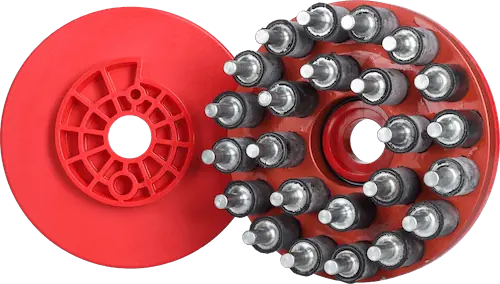
Slag removal is carried out through a mechanical removal process. During this process step, deslagging brushes are used to break the mechanical bond between the slag deposits and the component surface.
This creates a uniform starting condition that supports consistent and reproducible downstream manufacturing processes.
By removing slag deposits, a uniform component surface is created that allows pre-grinding tools to engage the material consistently.
Without this process step, uneven material removal, increased tool wear and unstable processing conditions can occur, reducing the reproducibility of subsequent operations.
The need for slag removal depends on the cutting process used. Slag deposits commonly occur during plasma cutting and oxy-fuel cutting and often need to be removed before further processing.
Laser-cut components typically produce significantly less slag. However, the actual requirement for slag removal depends on the resulting component condition and the requirements of subsequent manufacturing processes.
Manual slag removal methods can lead to uneven material removal and inconsistent component quality because the results depend heavily on the operator and the application technique.
In addition, manual processes are time-consuming and offer lower reproducibility compared to mechanized slag removal methods, making them less suitable for consistent manufacturing conditions.
Slag creates uneven surface conditions and localized material build-up on the component. As a result, coating thickness can become inconsistent and coating defects may occur.
This can negatively affect the adhesion of coating systems and reduce the quality and consistency of the finished component.
The purpose of slag removal is to create a defined component condition free from heavy slag deposits and other coarse attachments. This allows tools used in subsequent processing steps to engage the component surface consistently.
As a result, slag removal provides the foundation for stable downstream manufacturing processes and reproducible processing results.
Your Contacts

Marc Böck


Anja Berscheit