
intermediate sanding of varnish on wood
Intermediate lacquer sanding to reduce surface irregularities, improve lacquer adhesion and create uniform wood surfaces between the individual coating steps.
Industrial intermediate lacquer sanding for uniform surfaces and stable lacquer build-ups
Intermediate lacquer sanding is a machining step within industrial woodworking for the controlled processing of already coated wood surfaces. Fine unevenness and surface irregularities are reduced in order to create a uniform surface effect.
The quality of intermediate lacquer sanding directly influences the surface appearance, feel and uniformity of further coating layers. Different wood types, coating materials and surface conditions place high demands on tool selection and machining parameters.
The aim of intermediate lacquer sanding is to achieve a defined surface condition with a uniform surface effect, reduced surface irregularities and improved conditions for the subsequent lacquer application.
Why is intermediate lacquer sanding necessary?
Several coating layers are often applied to visible surfaces of wooden workpieces. Intermediate lacquer sanding is carried out between pre-coating, base coating and subsequent lacquer layers in order to smooth the surface in a controlled manner and prepare it for the further coating build-up.
During the coating process, wood fibres can stand up or fine unevenness can occur within the surface. Water-based lacquers and primers in particular cause wood fibres to swell, making the surface feel rough.
In addition, dust inclusions, small lacquer unevenness or excess coating films can affect the uniformity of the surface. Without controlled intermediate lacquer sanding, uneven surface patterns, visible surface defects or varying coating conditions often occur.
Intermediate lacquer sanding specifically reduces these surface irregularities and creates uniform conditions for further coating steps.
This creates more uniform surface patterns and controlled surface effects along the entire workpiece surface.
Intermediate lacquer sanding to improve lacquer adhesion
A central aim of intermediate lacquer sanding is to create a uniformly sanded surface in order to support the adhesion and uniformity of subsequent lacquer layers. Through controlled material removal, the surface is processed uniformly between the coating steps and prepared for the further lacquer build-up.
Especially with multi-layer coating build-ups, the uniformity of intermediate sanding directly influences the stability and quality of the subsequent lacquer layers. Uniform intermediate sanding improves the distribution of further coatings and supports stable lacquering conditions.
At the same time, subsequent processes such as final sanding or polishing are facilitated, as the surface has already been evened out in a controlled manner.
The result is more uniform coating conditions and reduced surface deviations within the lacquer build-up.
Uniform surface effect between the coating layers
Intermediate lacquer sanding is used to even out the surface between individual coating layers in a controlled manner. Fine raised areas along the surface are reduced in the process.
The intensity of intermediate lacquer sanding depends, among other factors, on wood type, coating condition, tool geometry and the selected machining parameters. Feed rate, rotational speed and contact pressure influence material removal and therefore the uniformity of the surface.
Sanding too aggressively can damage the coating, while uneven processing can impair the adhesion of subsequent lacquer layers. The aim is therefore a uniformly matt surface without local sanding through.
Controlled intermediate lacquer sanding creates uniform conditions for further machining steps and supports uniform visible surfaces.
Intermediate lacquer sanding with fine abrasives
Fine abrasives are used for intermediate lacquer sanding in order to process coated wood surfaces in a controlled manner and reduce surface irregularities.
The uniform tool engagement reduces fine unevenness and smooths the surface in a controlled manner. This creates a more uniform surface effect between the individual coating layers.
Depending on the surface requirement and coating condition, different abrasives and tool designs are used. The selection of tool configuration and machining parameters influences the intensity of material removal as well as the uniformity of the surface effect.
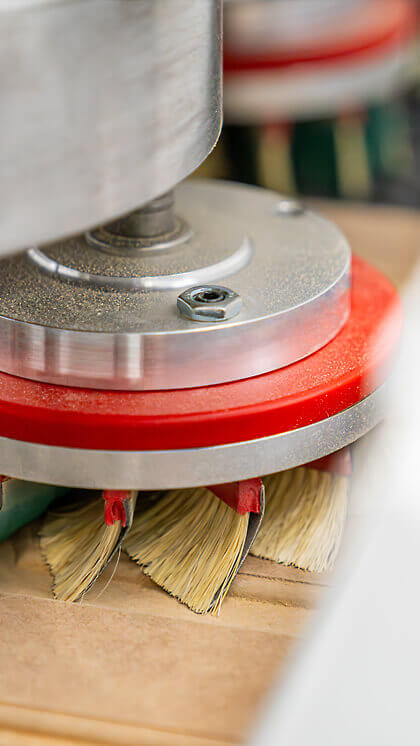
Among other tools, sanding brush discs can be used for intermediate lacquer sanding in order to process coated wood surfaces uniformly and reduce fine surface irregularities in a controlled manner. This creates a more uniform surface pattern between the individual coating steps and stable conditions for the subsequent lacquer application.
The result is a defined surface condition with reduced surface irregularities and uniform surface quality.
Quality characteristics of uniform intermediate lacquer sanding
The quality of intermediate lacquer sanding directly influences the visual quality of decorative surfaces. Unevenly processed coatings lead to visible surface deviations, rough surface areas and uneven lacquer finishes. Unevenly processed coatings lead to visible surface deviations, rough surface areas and uneven lacquer finishes.
Controlled intermediate lacquer sanding improves surface smoothness and evens out small dust inclusions, lacquer nibs and fine unevenness.
Especially with matt or high-gloss visible surfaces, the quality of the pre-processing becomes visible. Uniform surface conditions support a high-quality feel and stable final lacquering.
Even in automated machining processes, the uniformity of the surface influences tool engagement as well as the stability of the machining results.
Controlled intermediate lacquer sanding reduces rework and supports uniform surface qualities in industrial woodworking.
Our tools for breaking the edges of wood


Success Stories from our Customers
Through customer-specific tool adaptations, process times can be significantly reduced. One customer application demonstrated that processing time during deburring was reduced by up to 80%.
The latest generation of deburring discs maximizes abrasive contact through an optimized flap arrangement and slot structure. This increases material removal at the sheet metal edge and significantly improves machine performance.
Customers benefit from our extensive application knowledge and process experience. This expertise helps create efficient manufacturing processes and supports reliable production performance.
Deslagging Brush in Action
You are currently viewing placeholder content from YouTube. To access the actual content, click the button below. Please note that this will involve sharing data with third parties.
More informationFAQ on intermediate lacquer sanding
Answers on intermediate lacquer sanding, tool selection and surface quality.
What effect does intermediate lacquer sanding have?
Intermediate lacquer sanding reduces fine surface irregularities and improves the uniformity of already coated wood surfaces. During processing, raised wood fibres, small unevenness and fine lacquer irregularities are evened out in a controlled manner. This creates a more uniform surface effect between the individual coating steps and stabilizes the quality of subsequent lacquer layers.
Why is intermediate lacquer sanding important?
Intermediate lacquer sanding improves the adhesion of subsequent lacquer layers and reduces visible surface defects within the coating build-up. Without controlled intermediate processing, uneven surface patterns, rough lacquer surfaces or visible lacquer irregularities often occur. Uniform intermediate sanding creates stable conditions for further lacquer layers and high-quality visible surfaces.
Why do wood fibers stand up after painting?
Water-based lacquers and primers in particular can cause wood fibres to swell and thereby roughen the surface. During the drying process, individual fibres stand up and create an uneven surface structure. This creates rough surface areas that can negatively affect the feel as well as the uniformity of further coating layers.
Which surface irregularities are reduced during intermediate lacquer sanding?
Intermediate lacquer sanding reduces raised wood fibres, dust inclusions, fine lacquer unevenness and local surface irregularities within the coating. In addition, small raised areas and uneven lacquer areas are smoothed in a controlled manner. This creates more uniform surface conditions between the individual coating steps.
Which tools are used for intermediate lacquer sanding?
Fine abrasives and sanding brush discs are used for intermediate lacquer sanding in order to process coated wood surfaces in a controlled manner. The tools enable uniform material removal along the surface and reduce fine surface irregularities reproducibly. Especially with sensitive visible surfaces, controlled tool engagement is essential for uniform lacquer finishes.
Why is a uniformly matt surface important?
A uniformly matt surface improves the conditions for stable lacquer adhesion and uniform final lacquering. Uneven surface areas often lead to varying coating absorption or visible lacquer deviations within the surface. Controlled intermediate lacquer sanding creates uniform surface conditions for subsequent lacquer layers and stable coating results.
Which factors influence intermediate lacquer sanding?
Wood type, lacquer type, number of lacquer layers, surface structure and machining parameters influence the result of intermediate lacquer sanding. Feed rate, rotational speed and contact pressure also have a direct effect on material removal and the uniformity of the surface. Different coating conditions therefore require coordinated tool and process selection.
What effect does intermediate lacquer sanding have on surface quality?
Intermediate lacquer sanding improves surface smoothness, reduces visible surface deviations and supports high-quality visible surfaces. At the same time, it creates more uniform conditions for further coating layers as well as stable conditions for final sanding or polishing processes. Especially with matt or high-gloss visible surfaces, the quality of intermediate sanding directly influences the final surface effect.
Your Contacts

Marc Böck


Anja Berscheit